LINK
Custom software development · Brisbane

Custom software developmentfor the business no product fits.

You have tried the platforms. They either do far more than you need or never quite the thing you need, and the gap gets filled with spreadsheets, re-keying and someone's memory. I build the system that fits - around how your business actually runs, on one database, owned by you.

I'm James Webb. LINK's nine businesses run on software I've built, and so do clients who moved off platforms that never matched how they work. You deal with me from the first conversation to handover.

James Webb, custom software developer and founder of the LINK group, Brisbane

James Webb

Founder, LINK Group

Custom business software, built around how you work.

Custom CRMs

Leads, customers and follow-up modelled on how you sell, not on a vendor's idea of a pipeline. LINK's own CRM was built this way, and so was a services client's.

Job, scheduling and quoting systems

Staff, jobs, schedules and quotes on one data model, so work stops slipping between the quote and the invoice. The build a tiling contractor moved off simPRO for.

Inventory and ecommerce back ends

Stock, customers and the storefront on one back end, with the web integration built for how you trade rather than the standard connector.

Integrations between what you already run

Xero joined to job management, CRM, payroll and POS, so data moves on its own instead of being re-keyed. Often the whole project, and the cheapest one.

Dashboards & Xero integration →

Internal tools and automation

Routing, scoring, follow-ups and the repetitive steps someone does by hand every day - the work that scales with headcount until it is automated.

AI where it earns its place

Models built for a specific job inside the system, not a chatbot bolted to the front. Where AI does not belong, it is left out.

AI consulting →

A build is usually one part of a wider business transformation, and once it is live the person who built it is worth keeping in the room - that is the fractional CTO engagement.

Custom CRM development, when the pipeline isn't yours.

Off-the-shelf CRMs assume a sales process. If yours does not look like it, you end up paying per seat for a tool your team works around - and the customer record still lives somewhere else from the jobs, the projects or the stock.

A custom CRM puts customers on the same database as the rest of the business. LINK's own lead management and CRM were built this way, replacing subscriptions across nine businesses, and a multi-service client now runs CRM, projects and people management as one system instead of an inbox.

I'll tell you to buy it when buying is right.

Most businesses do not need custom software. They need the tools they already pay for connected properly and two or three processes automated, and that is what you'll hear in the first conversation if it is true. Custom is worth it when no product matches how you run - and the cost of that mismatch is usually hiding in leaked hours and unbilled work, not on a subscription line.

Not sure which you need? Start with a systems review - mapping how the business runs comes before deciding what to build.

Three platforms I've built, front end to back end.

Three industries - finance, recruitment, events - and one builder. These are my own products and ventures rather than client work, which is exactly why they are here: you can see the public site, the screens behind the login, and the engineering facts you could check, before we have spoken.

Every screenshot shows demonstration data. Where a product is not yet live, it says so.

01FinanceInvite-only · paper mode

FEUM

Fund an account in Australian dollars, buy BTC, ETH, SOL, USDT or USDC with a fee you can see, hold it or move it to your own wallet.

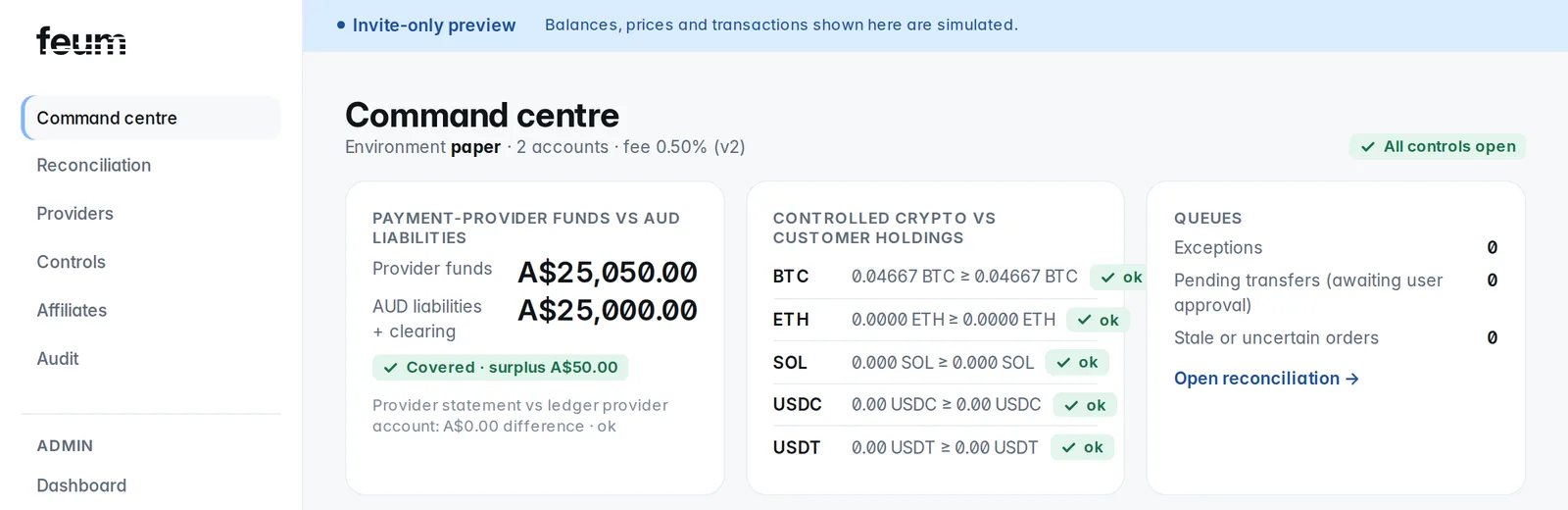
My own venture, and the most demanding build of the three: money in motion, where a rounding error or a double-submitted order is a real loss. I built the brand kit, the marketing site, the member app and the owner's admin, the Command centre.

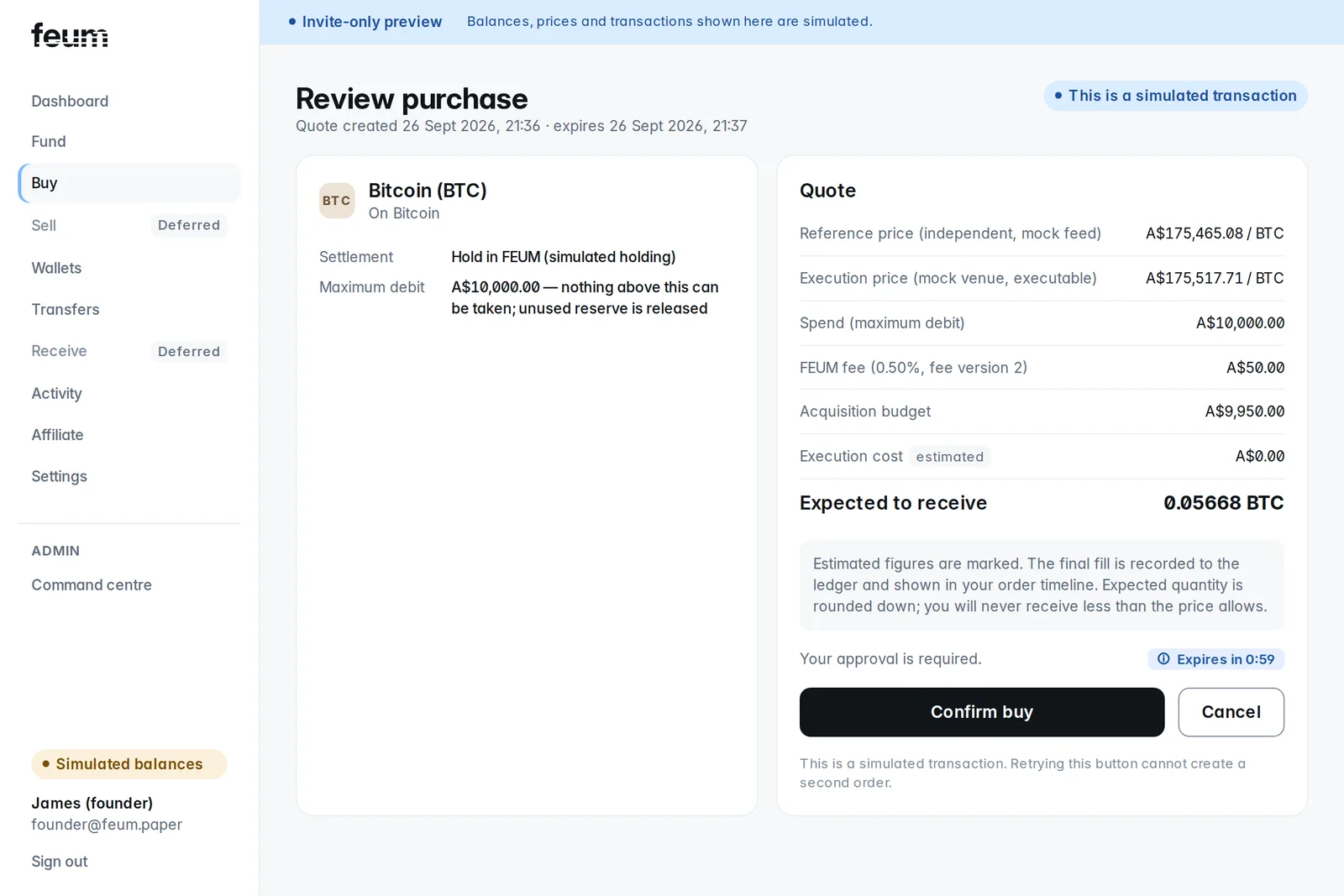
The rule the whole system is built around: deposits never trigger purchases. Every buy and every transfer needs explicit approval. The member app and back end run in paper mode with simulated funds only, and membership is by invitation.
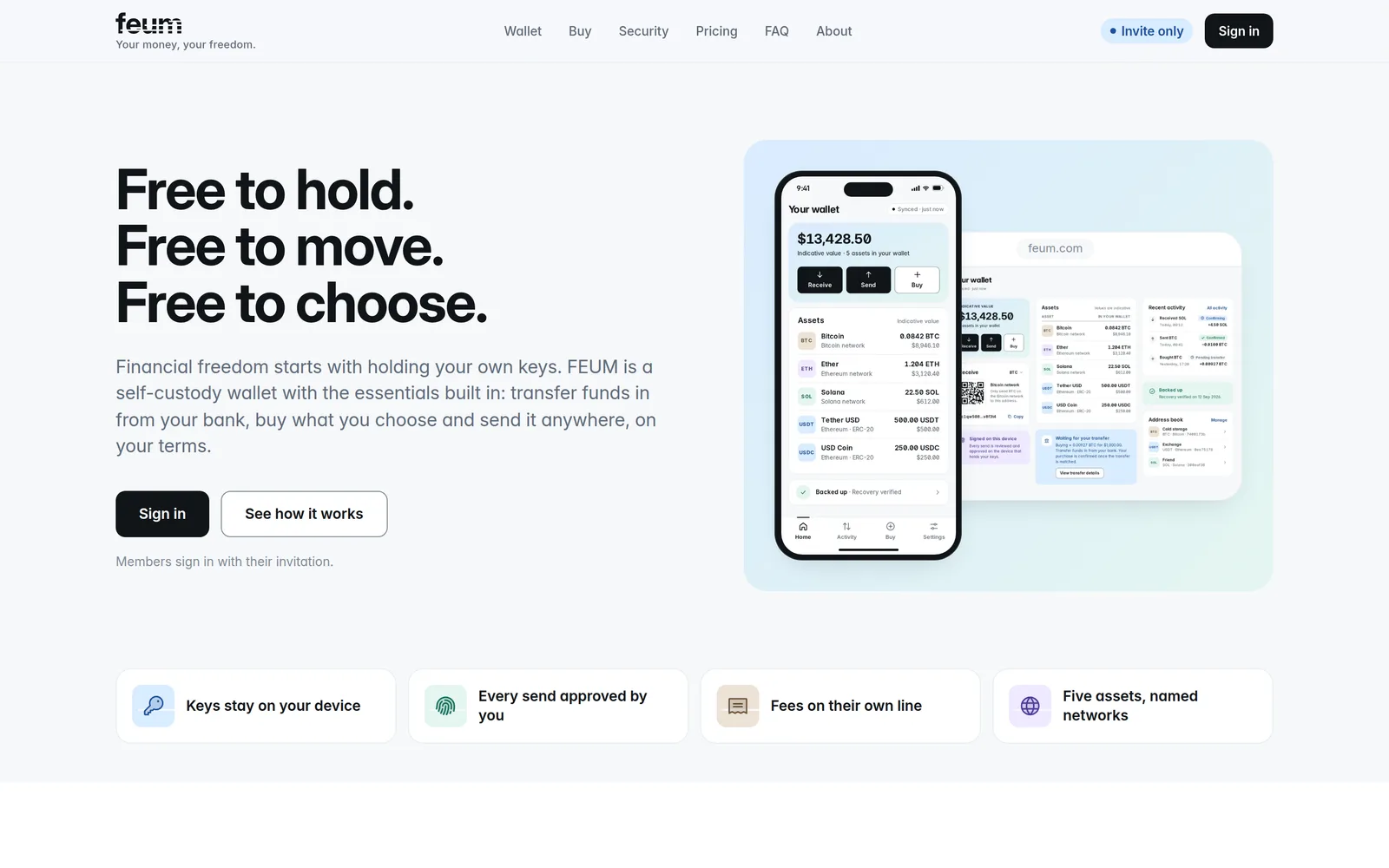
feum.com
feum.com
FEUM public homepage: the headline 'Free to hold. Free to move. Free to choose.' beside a phone showing a wallet with five assets, with an invite-only badge in the navigation
FEUM member app, Review purchase screen for Bitcoin: reference and execution prices, a maximum debit of A$10,000, the 0.50% fee on its own line, expected quantity to receive, a quote expiring in 60 seconds and a note that your approval is required. Banner reads: this is a simulated transaction.

Member app, paper mode: the quote holds for 60 seconds, the fee sits on its own line, and nothing moves until you approve it. Simulated balances.

What I built

  • Member app: available, pending and reserved balances; fund; quote with a 60-second expiry; buy
  • Wallet address book with asset and network validation
  • Transfers with step-up approval; activity and order timelines
  • Command centre: reconciliation of provider funds vs liabilities and crypto vs holdings, provider health, audit trail, CSV exports
  • Owner controls, including fee change and pause - every admin action needs a reason plus step-up re-authentication
  • Double-entry ledger with immutable postings and reversal-only corrections; money held in integer cents and base units
  • Fee version snapshotted on every quote; provider-neutral payment and liquidity adapters

Checkable facts

  • 92 automated tests against a real PostgreSQL 16 database
  • 5 database migrations
  • 3 end-to-end scenarios passing on desktop and mobile

Next.js · TypeScript · Postgres
02RecruitmentLive

Recruited

Recruitment software for Australian agencies - CRM and ATS in one workspace, private to each agency.

A LINK venture, built by the team behind LINK, and LINK runs its own recruitment desk on it as an ordinary customer. That is the honest version of dogfooding: if the Today screen is wrong, I hear about it that morning.

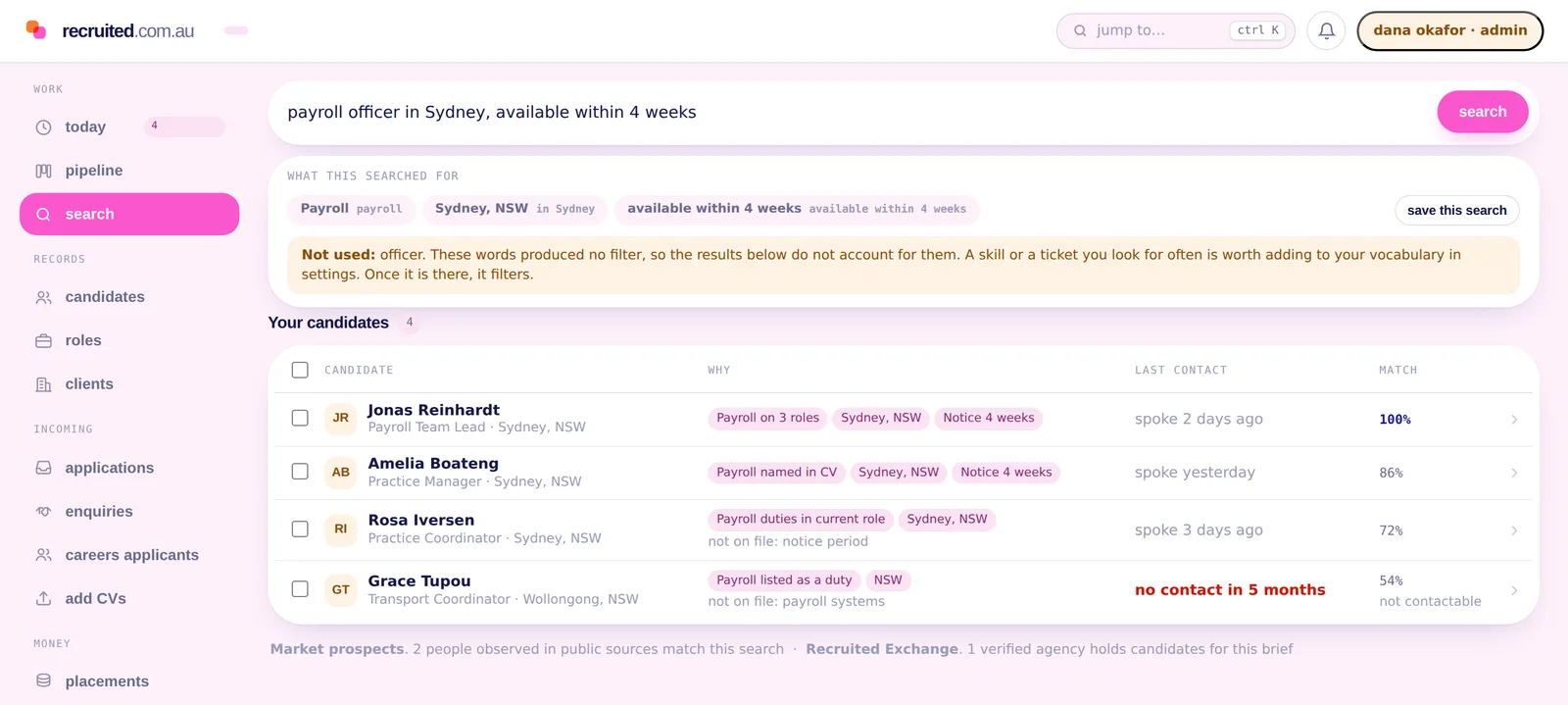
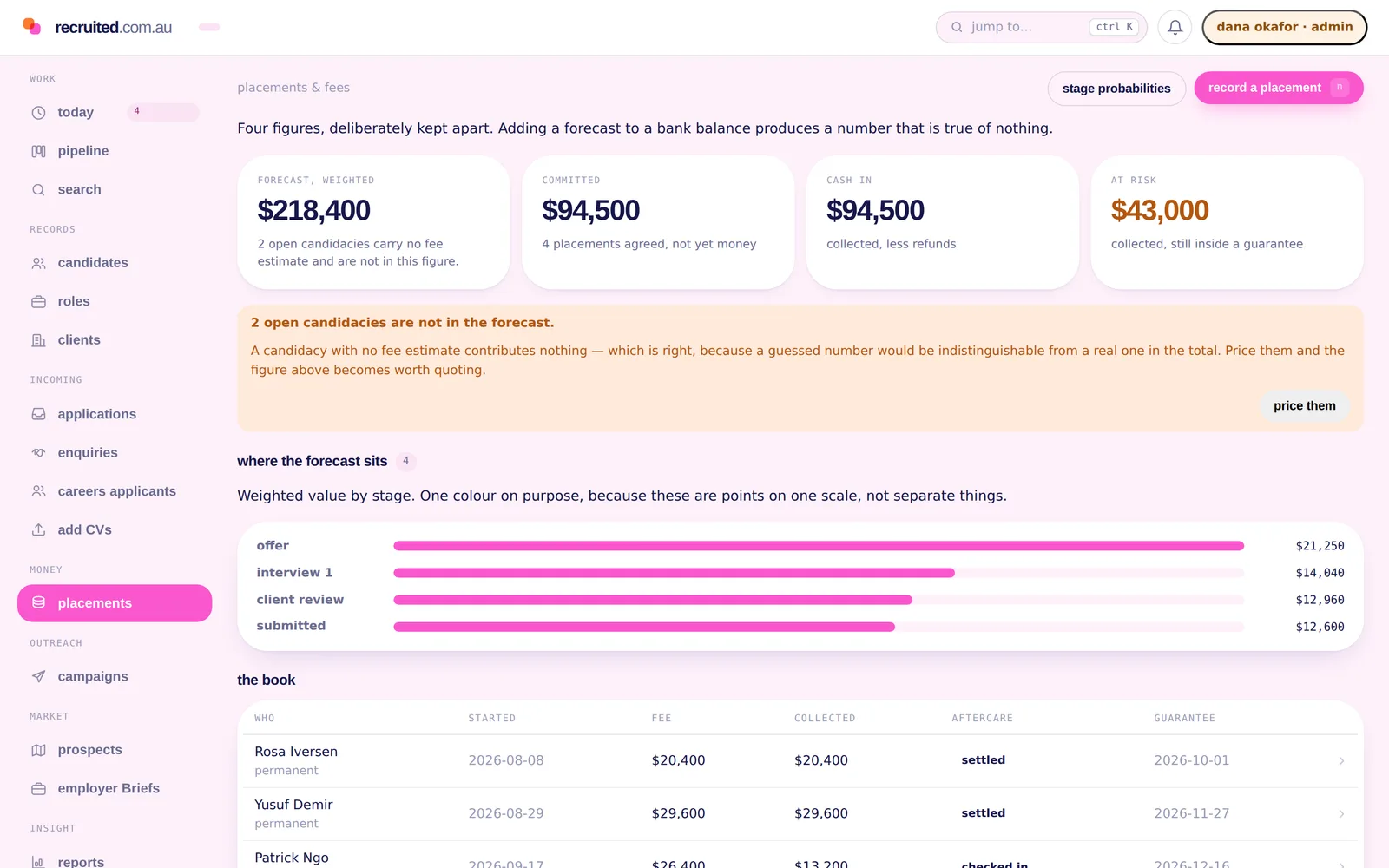
The design brief was that the software should always show its working. Search shows the filters it applied and the reason for every match. Deal Desk keeps forecast, committed, cash in and at risk as four separate numbers, because adding a forecast to a bank balance gives you a figure that is true of nothing.

recruited.com.au
recruited.com.au
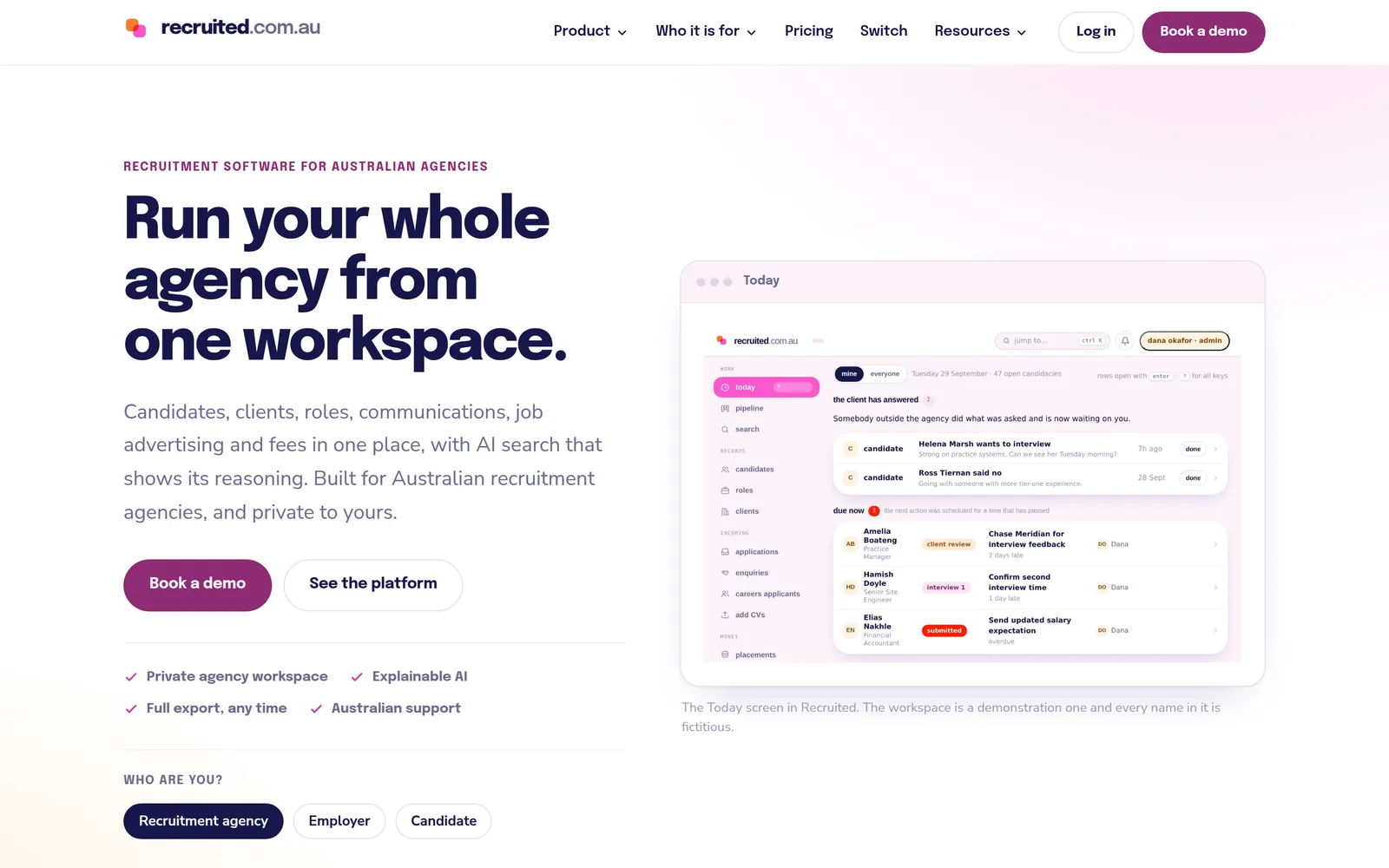
Recruited public homepage: 'Run your whole agency from one workspace' beside a framed capture of the app's Today screen, with Book a demo and See the platform buttons
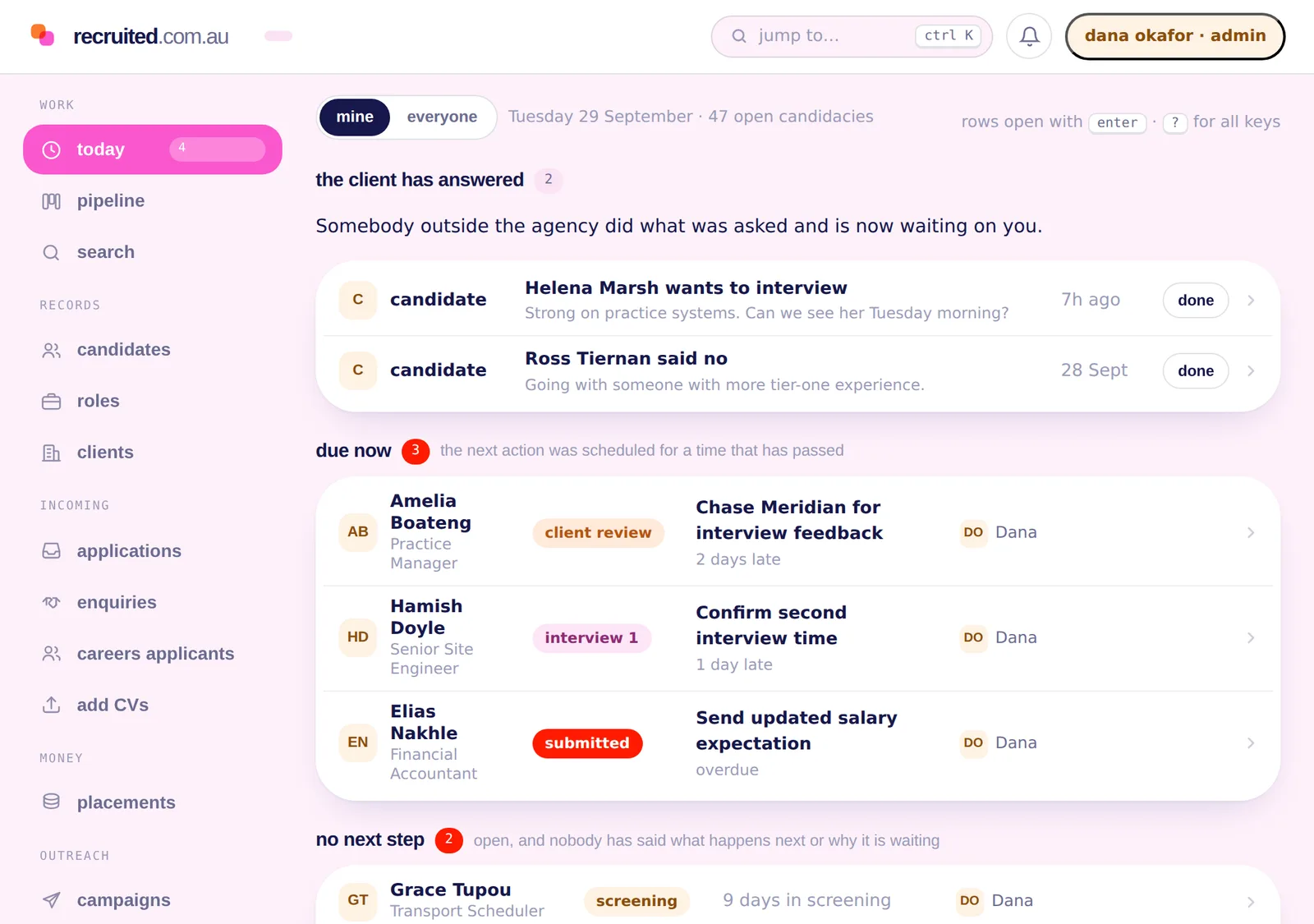
Recruited Today screen: candidates grouped under 'the client has answered', 'due now' with how many days late each next action is, and 'no next step', each row with the candidate, stage and the person responsible

Today: what needs action now, grouped by why it needs you. Demonstration workspace, every name fictitious.

What I built

  • Today screen: what needs action now
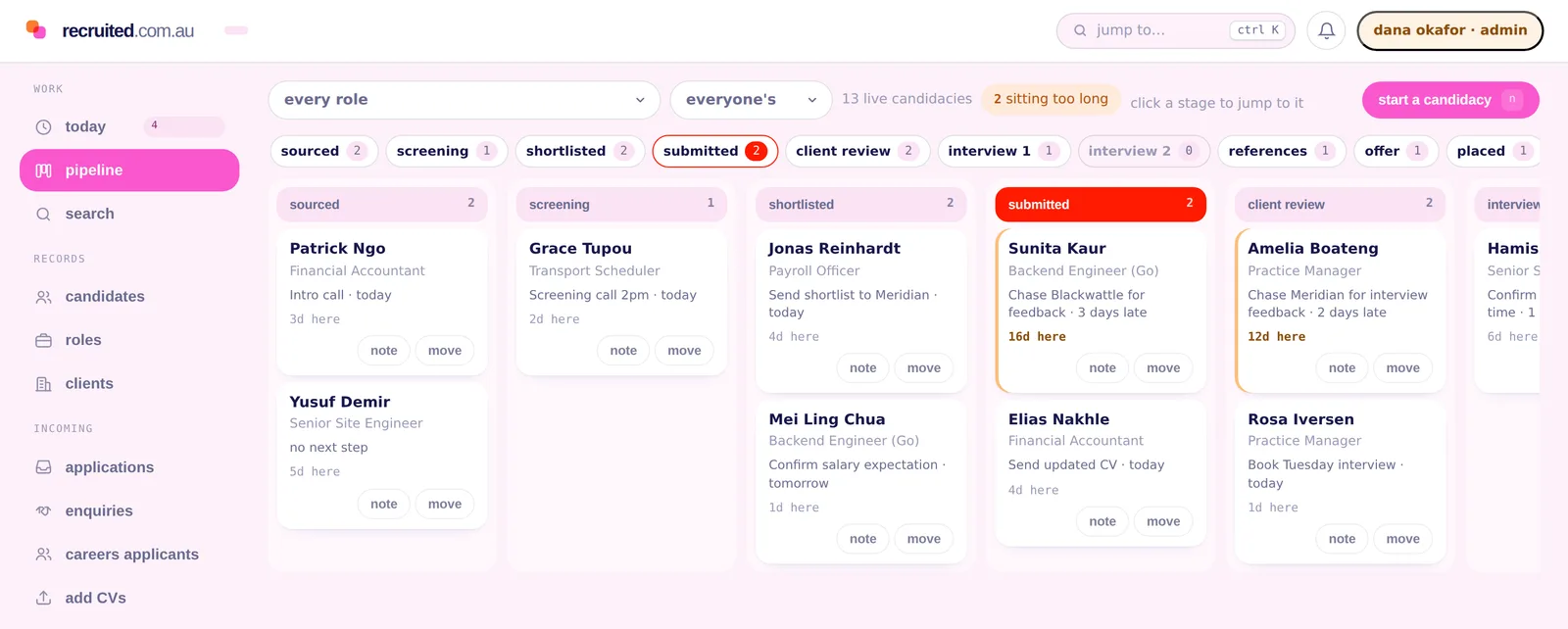
  • Pipeline with append-only stage history and stalled alerts
  • Explainable search: the filters it used and the reason for every match
  • Deal Desk: append-only fee ledger with forecast, committed, cash in and at risk kept separate
  • Client portal with CV redaction and approval
  • Owned job pages and applications
  • Email campaigns that cannot send until the agency verifies its own domain, with unsubscribe and suppression
  • CV text extraction from PDF and Word
  • TOTP two-factor authentication and audit history; full import and export
  • Workspace tenancy enforced in one place, failing closed

Checkable facts

  • 31 API endpoints
  • 22 database migrations
  • 56 test files
  • Zero npm dependencies

Static HTML · serverless functions · signed, revocable session tokens - the browser never holds a database key

03EventsPre-launch

Eventman

Software for the businesses that turn up and work the event - mobile bars, catering, hire and entertainment.

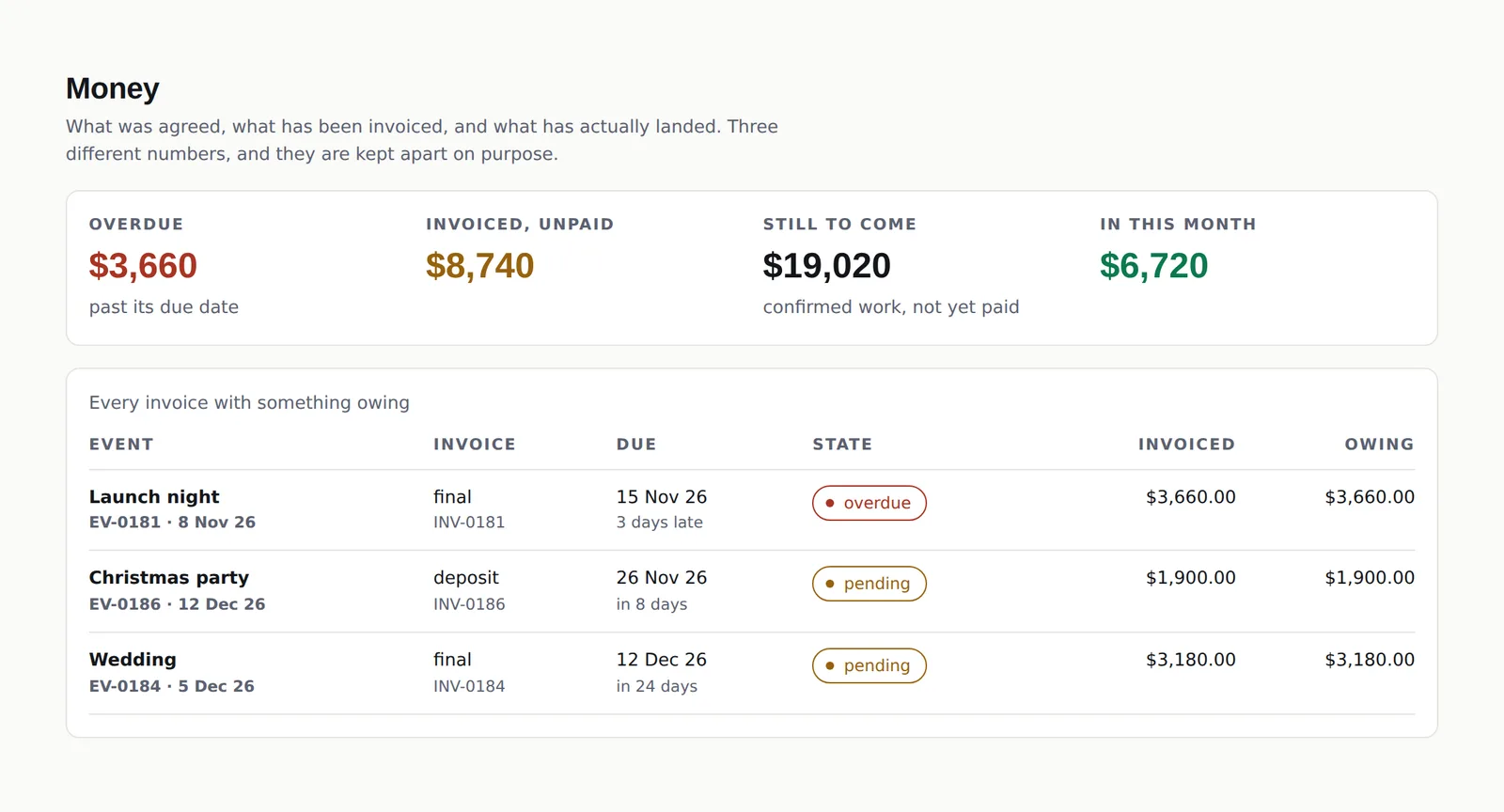
My product, built alongside a working events business as its first operator, so every screen answers a question somebody in that office asks on a Tuesday: what is outstanding on Saturday's wedding, who has not said yes to their shift, and what is still owed.

Nothing here started from a blank file. The security and tenancy core is the one proven in Recruited; the design system is FEUM's. That is the thread through all three builds: each one makes the next one faster, and that is what you are hiring when you hire me.

Not yet public. Ask me for a walkthrough.

eventman
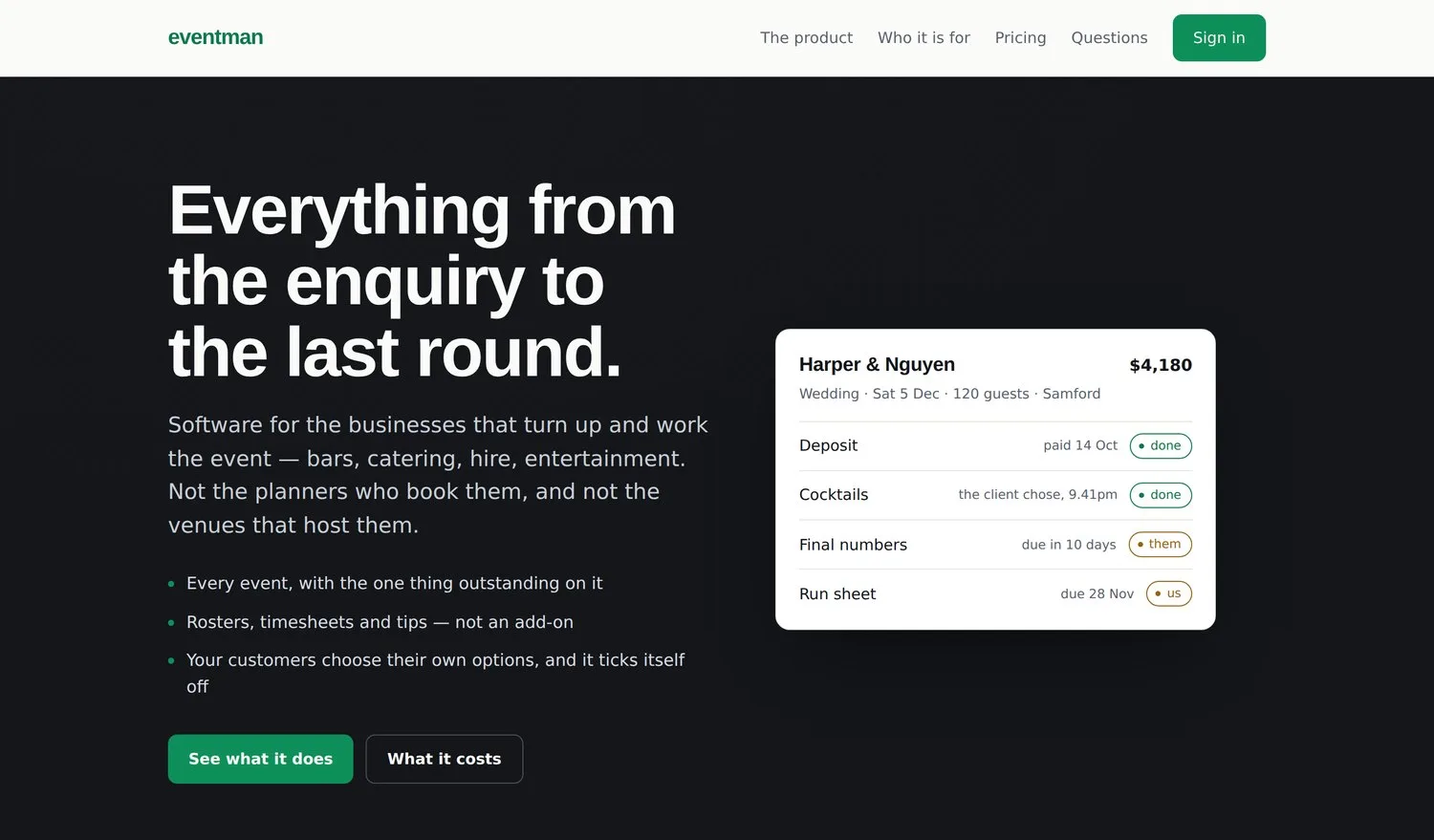
Eventman website hero: 'Everything from the enquiry to the last round' beside an event card for a 120-guest wedding showing deposit paid, cocktails chosen by the client, final numbers due and the run sheet due
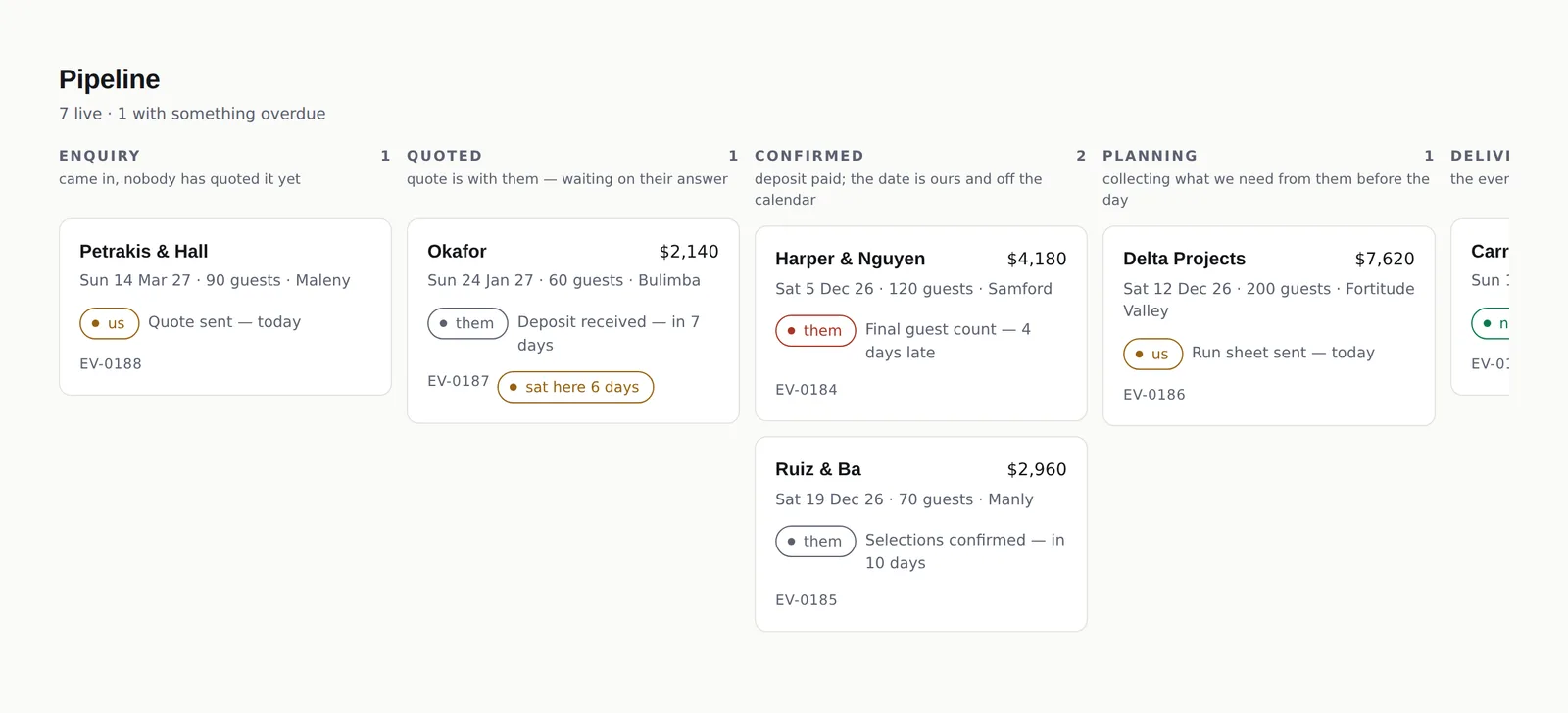
Eventman pipeline board with enquiry, quoted, confirmed, planning and delivery columns, each with a one-line meaning, and event cards showing date, guests, suburb and whose move it is next

The seven-stage board. Every stage has a stated meaning, and every card says whose move it is. Demonstration data.

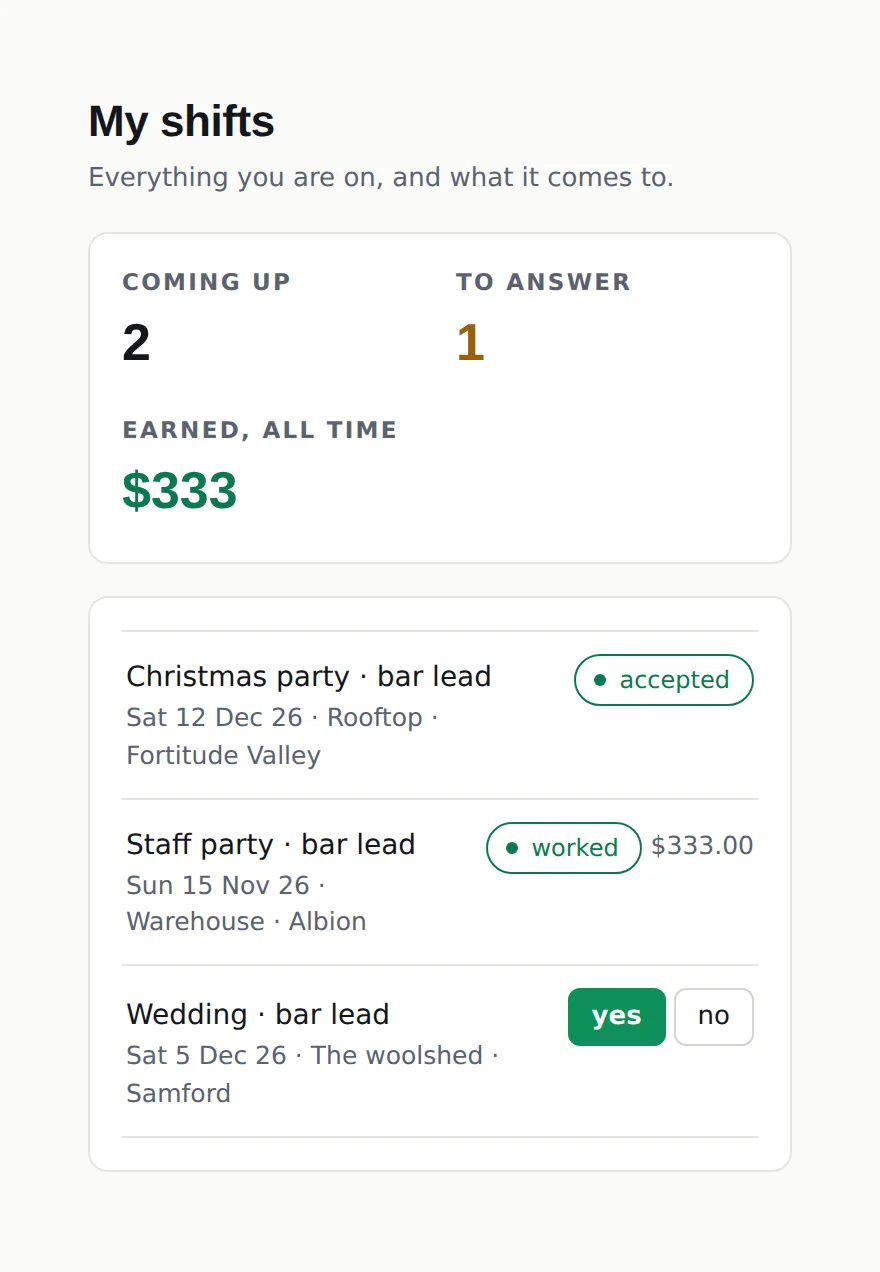
Eventman 'My shifts' phone view for a casual staff member: shifts coming up, one to answer, earnings to date, and a yes or no button on an offered wedding shift

The staff side is a phone page, not an app to install.

A casual's own phone view: their shifts, the one waiting on an answer, and what it comes to.

Demonstration data.

What I built

  • Enquiry intake any website can post to - rate-limited and de-duplicated
  • Seven-stage event board where every stage has a stated meaning
  • Per-business requirement checklists that re-date themselves when the event moves
  • Today view and a daily digest
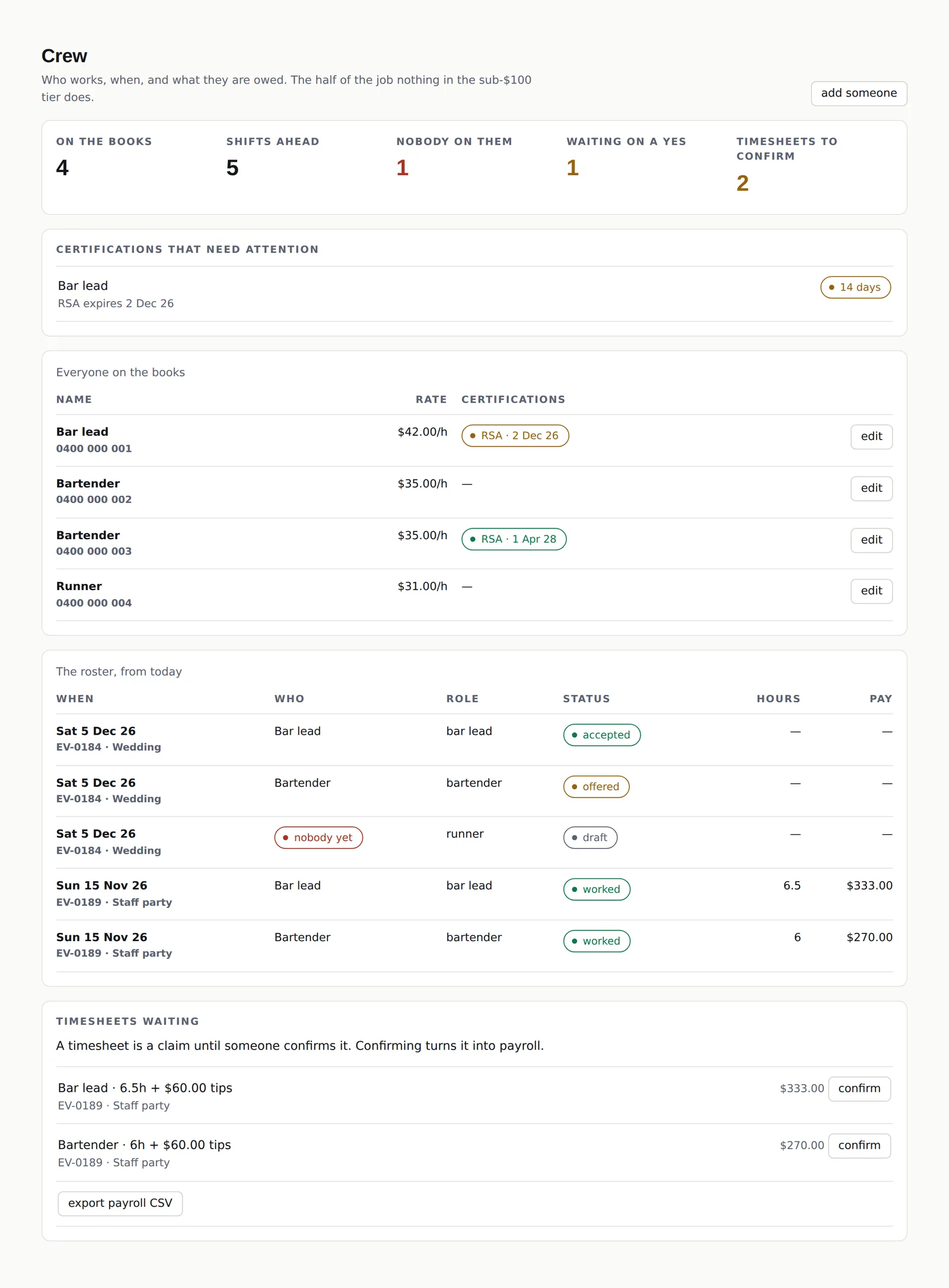
  • Crew with pay rates and certification expiry
  • Shift offers accepted or declined, with double-booking warnings
  • Timesheets and payroll CSV; a casual's own "My shifts" phone view
  • Quotes, deposits, final invoices and money owed across the business
  • Customer portal on a tokenised link, no login: the customer picks options, confirms numbers and accepts the quote, and the office checklist ticks itself off

Checkable facts

  • 12 API endpoints
  • 3 migrations
  • 29 unit tests on the date, money and pay arithmetic
  • Zero runtime dependencies

Security and tenancy core from Recruited · design system from FEUM

Same approach for your build: one person from the first conversation to handover, a working version early, and a system you own outright at the end.

Talk about your build

And for clients, running in their businesses.

Commercial tiling contractor

Custom job, scheduling, quoting and staff system

Off simPRO, $55,000 saved in systems cost - and the bigger win was the revenue that had been leaking through project management.

Large online retailer

Inventory, customer management and storefront integration

One back end instead of three products and the glue between them.

Multi-service online business

CRM, project and people management in one system

The inbox stopped being the system of record, and the same team takes on more work.

LINK's own nine businesses

Custom CRM, lead management and automation

Around $40,000 a year of software subscriptions replaced.

The full write-ups →

Common questions.

→How much does custom software development cost?

It depends on three things: how many systems it has to talk to, how much of your process it has to model, and how much of it already exists in a product you can keep. An integration between two tools you already run is the small end. A back end that replaces a platform - jobs, scheduling, quoting, customers on one database - is the large end, and it is still less than custom software cost a decade ago. You get a scoped quote before you commit, and the number to compare it against is the per-seat subscriptions and the leaked hours the current setup already costs you.

→Should we build custom software or buy something off the shelf?

Buy, if something fits. It is cheaper and faster, and I'll tell you so. Build when no product matches how you run - and that is as often a platform doing far more than you need as one doing too little. The tiling contractor on this page was not too big for simPRO; it simply never fitted how they worked.

→What is custom business software?

Software built around one business's own process and data, rather than a product built for the average of a market. In practice it is usually a back end - CRM, jobs, scheduling, inventory, quoting - plus the integrations that tie it to the tools you keep, like Xero.

→Can you build a custom CRM?

Yes. LINK's own CRM, lead management and automation were built in-house, replacing subscriptions, and a multi-service client runs CRM, projects and people management on one custom system. A custom CRM makes sense when your sales process does not fit a vendor's pipeline model, or when the CRM needs to share one database with jobs, projects or stock.

→Who actually builds it?

I do. You deal with me from the first conversation to handover - not an account manager in front of a development team. If you have your own developers or IT team, the architecture can come from here and they can build it, which is often the cheapest way.

→Do we own the code?

Yes. At handover the code and the database are yours - nothing is licensed back to you, and nothing stops working if you stop dealing with me. Your own developers can take it on later.

→How long does a custom build take?

Weeks for an integration or a couple of automated processes; months for a platform with its own data model, because mapping the process is most of the work and rushing it means building twice. You see a working version early, while it is still cheap to change your mind about how it should work.

→Are the three platforms on this page client projects?

No - they are my own. FEUM is my venture, Recruited is a LINK venture that LINK's own recruitment desk runs on as an ordinary customer, and Eventman is a product I am building with a working events business as its first operator. They are on this page because they show what I build when the brief is mine, front end to back end, and because each one reused the proven core of the last - the same security and tenancy core, the same design system - which is what makes a client build faster and safer. The client work is in the section below them, described without names.

→Do you only work with Brisbane businesses?

No. Most custom software I build for Brisbane businesses is built remotely anyway, so clients are Australia-wide. LINK is in Fortitude Valley, and Brisbane clients get in-person sessions where they help.

Tell me what you need and what you run today.

This goes straight to my inbox, not a sales team. You'll get a straight read on whether a build is worth it - including when the answer is to buy something instead.

What are you after?

How far along are you?

This goes straight to James, who does the work - not a sales team. If the honest answer is that you don't need a custom build, you'll get that answer.